
Compare
Compare answers whether a code, prompt, model, tool, or configuration change altered agent behavior. It does not prove that the candidate is better by itself.
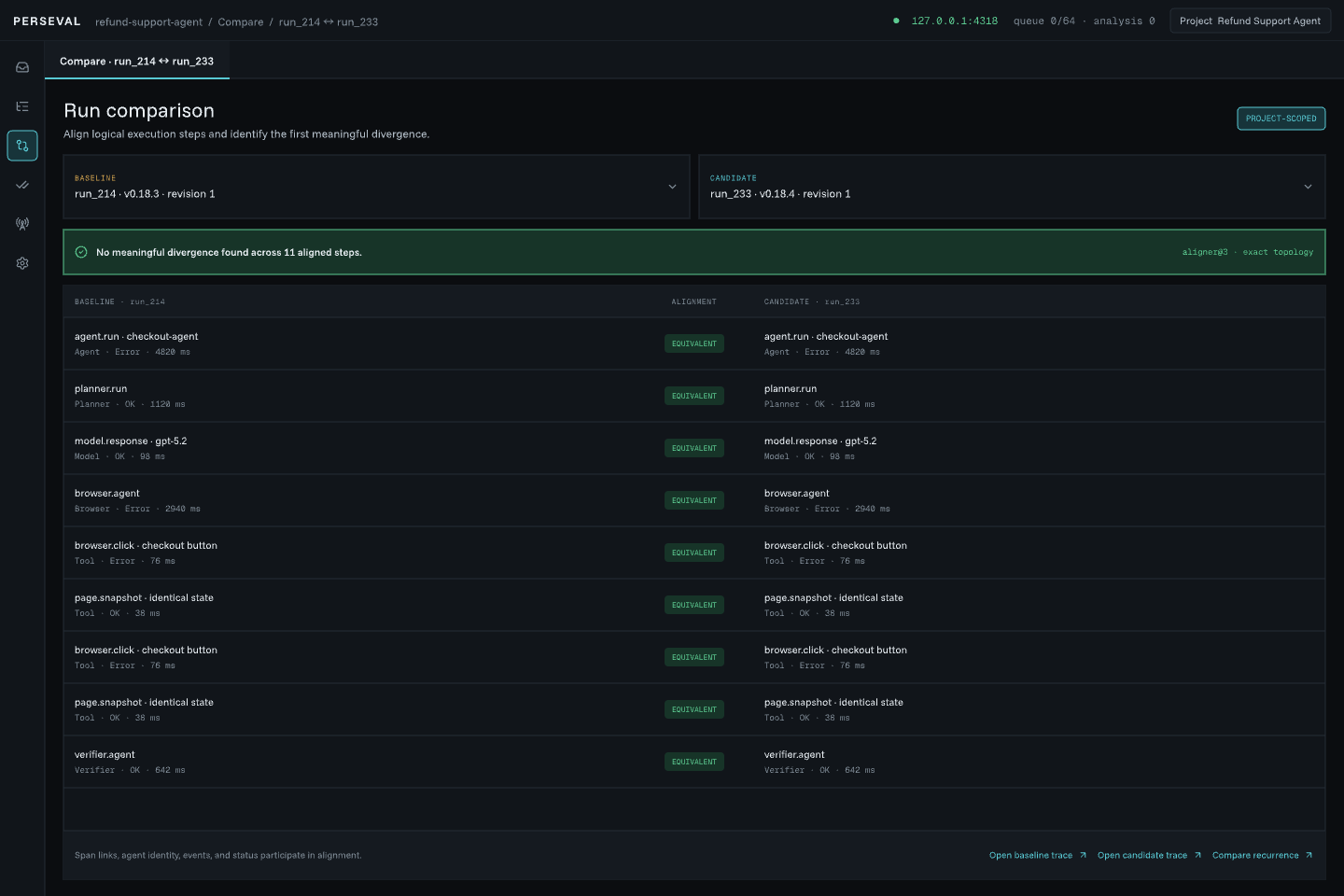
Select a pair
Section titled “Select a pair”In Runs, select exactly two distinct finalized revisions from one project. Select the baseline first and the candidate second. Use explicit build, environment, and session filters so the orientation is meaningful.
Compare is unavailable when:
- fewer or more than two runs are selected;
- a run is still live;
- both selections resolve to the same revision;
- the pair belongs to different projects.
Live refresh preserves valid selections by stable identity.
Alignment
Section titled “Alignment”Perseval aligns equivalent responsibilities and operations while preserving agent identity. The result labels rows Equivalent, Changed, baseline-only, or candidate-only.
Alignment is bounded and persisted. A very large input can produce a bounded comparison view instead of materializing every step.
First meaningful divergence
Section titled “First meaningful divergence”The summary identifies the first changed execution step after an equivalent prefix. Root outcome is treated as a summary rather than automatically being called the cause when a later tool or publisher step is the first behavioral change.
Example:
First meaningful divergence after 5 equivalent steps:publisher.submit_return status changed from Error to OK.Inspect the surrounding equivalent steps to test a causal story. A changed downstream verifier may be a consequence, not the first divergence.
Honest no-divergence result
Section titled “Honest no-divergence result”Equivalent traces report no meaningful divergence. Perseval does not invent a cause when the bounded alignment has none. Differences in external quality, payload semantics, or omitted content may still exist outside the structured projection.
Use with evals
Section titled “Use with evals”A repaired candidate plus a verified baseline failure is useful evidence for an eval definition. Perseval still stops at definition and review; it does not re-execute the agent or certify remediation.